“How much does it cost to renovate a 100 sqm home?” It is probably one of the first questions we ask ourselves when we begin thinking about a renovation.
And it is a perfectly reasonable one.We need to understand whether our budget is realistic, how much we can allocate to the works, and how much we should reserve for furniture and finishes.
The problem is that 100 square metres, on their own, tell us very little. We may have a 100 sqm home where we keep the existing flooring, layout and part of the services. And another, exactly the same size, where we move the kitchen, renovate two bathrooms, alter the services, remove walls, replace the windows and introduce bespoke joinery.
They are both 100 sqm homes.
But they are two entirely different renovation projects. So let’s look at five things that can genuinely change your quote.
Let’s start here. Searching online for a generic “renovation cost per square metre” can be useful if you simply want a very rough sense of scale.
But it is unlikely to tell you what your home will actually cost. A bedroom where we only need to work on flooring, walls and lighting has one level of complexity.
A kitchen of exactly the same size, where we need to move water supplies, drainage, electrical points, gas or other technical systems, has another. The same applies to bathrooms. This is why two homes with the same floor area can require very different levels of investment.
Before looking at the square metres, we need to understand what is going to happen inside them. And this is where the design already begins to shape the budget.
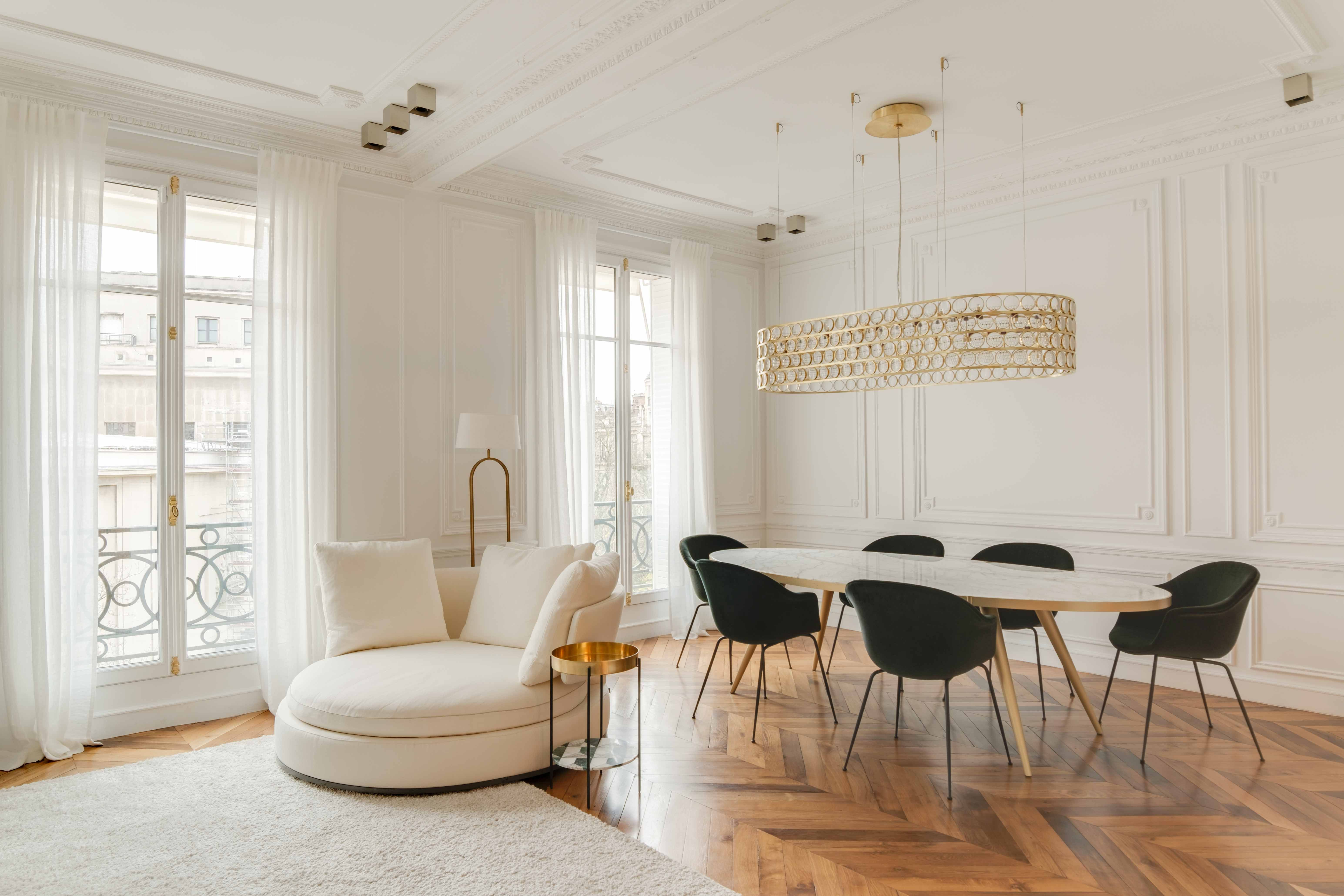
On site, even a relatively small layout change can involve several different trades. This is why the floor plan is not only an aesthetic decision. It is also a financial one.
This is perhaps one of the most important things to understand once quotations start arriving. “Complete bathroom renovation.”
It sounds clear. In reality, it can mean many different things.
What size will the tiles be? Where will they be laid? Are we choosing a standard shower or a large-format slab? Will there be niches? Exposed or concealed taps? Standard or wall-hung sanitaryware? An off-the-shelf vanity or a bespoke one? How many lighting points? And which materials?
Every choice affects materials, quantities, installation times and labour. The same principle applies throughout the home.
“Parquet”, “lighting”, “doors” or “kitchen” are not yet detailed enough specifications to compare two quotations properly. This is one reason why three contractors can return three very different prices.
Not necessarily because one company is dramatically more expensive than another. Sometimes they are simply pricing different things.
When the budget is fixed, the first instinct is often to reduce every item. We prefer to ask a different question:
Where is it actually worth investing? Perhaps the existing parquet can be restored. Perhaps the entire bathroom does not need to be clad in an expensive stone, and we can use it only where it has the greatest impact.
We may choose a simpler kitchen and invest instead in a beautiful dining table designed to remain in the home for years. Or remove a few decorative elements in order to properly design a piece of bespoke joinery that solves an entire room.
Budget planning means this too.
Deciding where to create value, and where to simplify without diminishing the overall result. It is often this hierarchy that makes the difference between a home that is simply expensive and one that has been thoughtfully designed.
A renovation works with something that already exists. And not everything is visible before the works begin.
Once old flooring, wall finishes or services are removed, conditions may emerge that require additional work. Then there are the changes that arise during the design process or on site.
An extra socket. A different detail. A material we decide to change. This is why it is wise not to commit every last euro of the budget before the project has even started.
How much contingency you should allow depends on the property and on the complexity of the renovation. A relatively recent home requiring limited work carries a very different level of uncertainty from an older property undergoing a complete renovation. There is therefore no perfect percentage that applies to every project.
There is only a sensible assessment of risk before the works begin.
This is where a great deal of confusion often begins. Imagine calling three contractors and saying:
“We would like to renovate this home completely. How much will it cost?”
One may assume a certain level of finishes. Another may leave out certain works. A third may include them. You will receive three numbers.
But what are you actually comparing?
Before asking for a reliable price, we need to define, as clearly as possible, what we intend to build. Layout. Demolitions and new partitions. Services. Flooring and wall finishes. Doors. Finishes. Bespoke elements.
Only once the project is sufficiently developed can we translate it into quantities and individual works and prepare a bill of quantities — a document that describes and measures the work to be carried out. At that point, comparing quotations becomes much clearer.
Because, as far as possible, we are asking each contractor to price the same home.
The most accurate answer is: it depends on what we want that home to become.
And this is not a way of avoiding the question. It is precisely why we believe the budget should be discussed very early in the process.
First, we define your priorities. We understand what is worth keeping. We study the transformations that are actually needed.
We decide where to invest and where we can be more restrained. Then we begin to build a more realistic financial picture.
Because the best project is not the one with the highest budget. It is the one in which space, aspirations and investment are able to find the right balance.
Before asking contractors for quotations, we can help you understand what is worth transforming, what should be kept, and which works are genuinely necessary.
Write to us at info@aqhitalia.com and tell us about your home.




.png)