It can bring rhythm to a long corridor, give greater presence to an entrance hall, frame a headboard in a bedroom, or simply add depth to a wall that feels too anonymous. But there is a subtle difference between an elegant boiserie and a wall that has simply been decorated with mouldings.
That difference is called proportion.
The first question should not be “Which boiserie should I choose?” but rather: “Does this room really need it?”
In very small spaces or rooms with low ceilings, for example, an overly elaborate boiserie can make the space feel heavier and visually lower. A long hallway, a strong feature wall in the living room, or a bedroom with generous proportions, on the other hand, can gain an extraordinary amount of character from it.
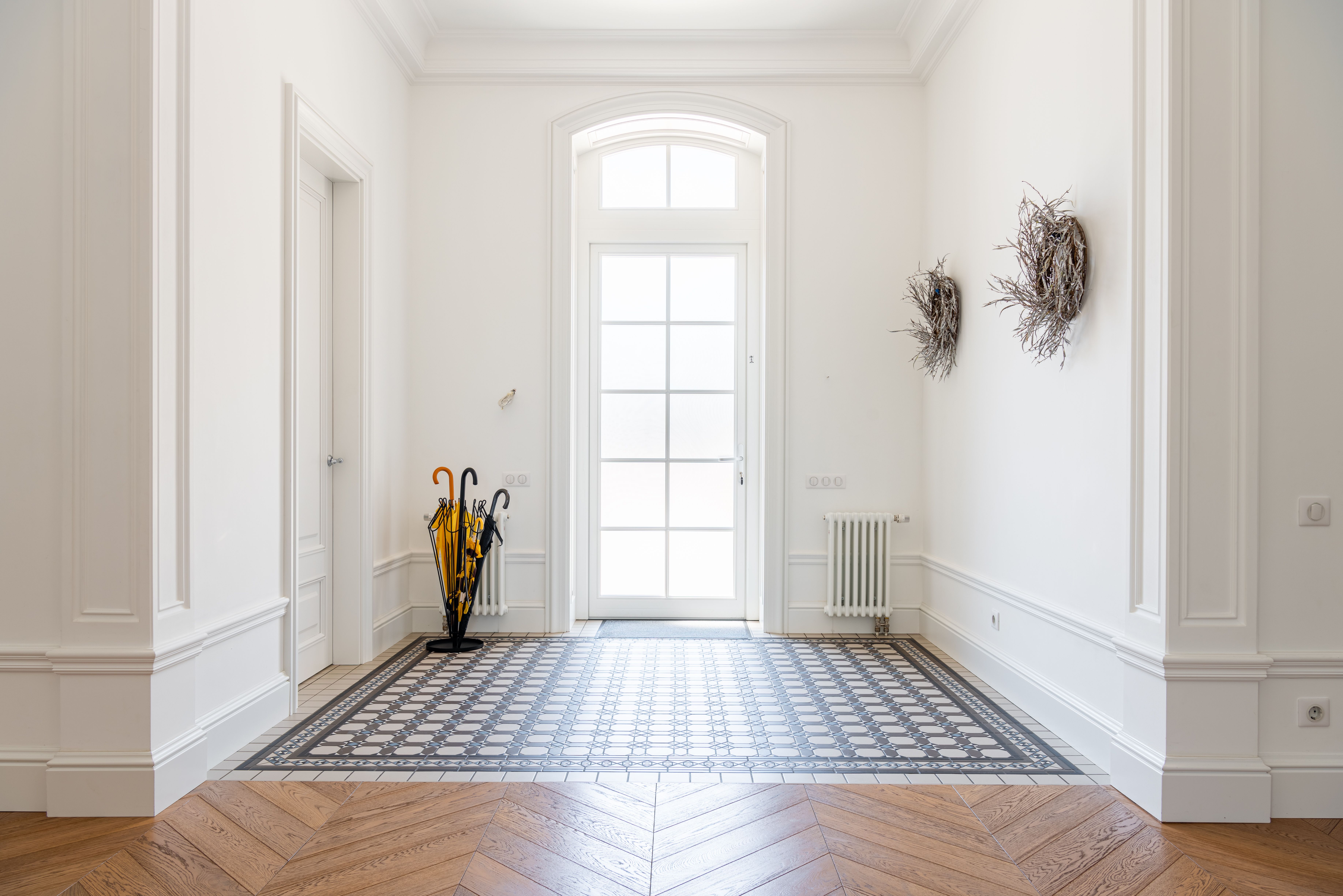
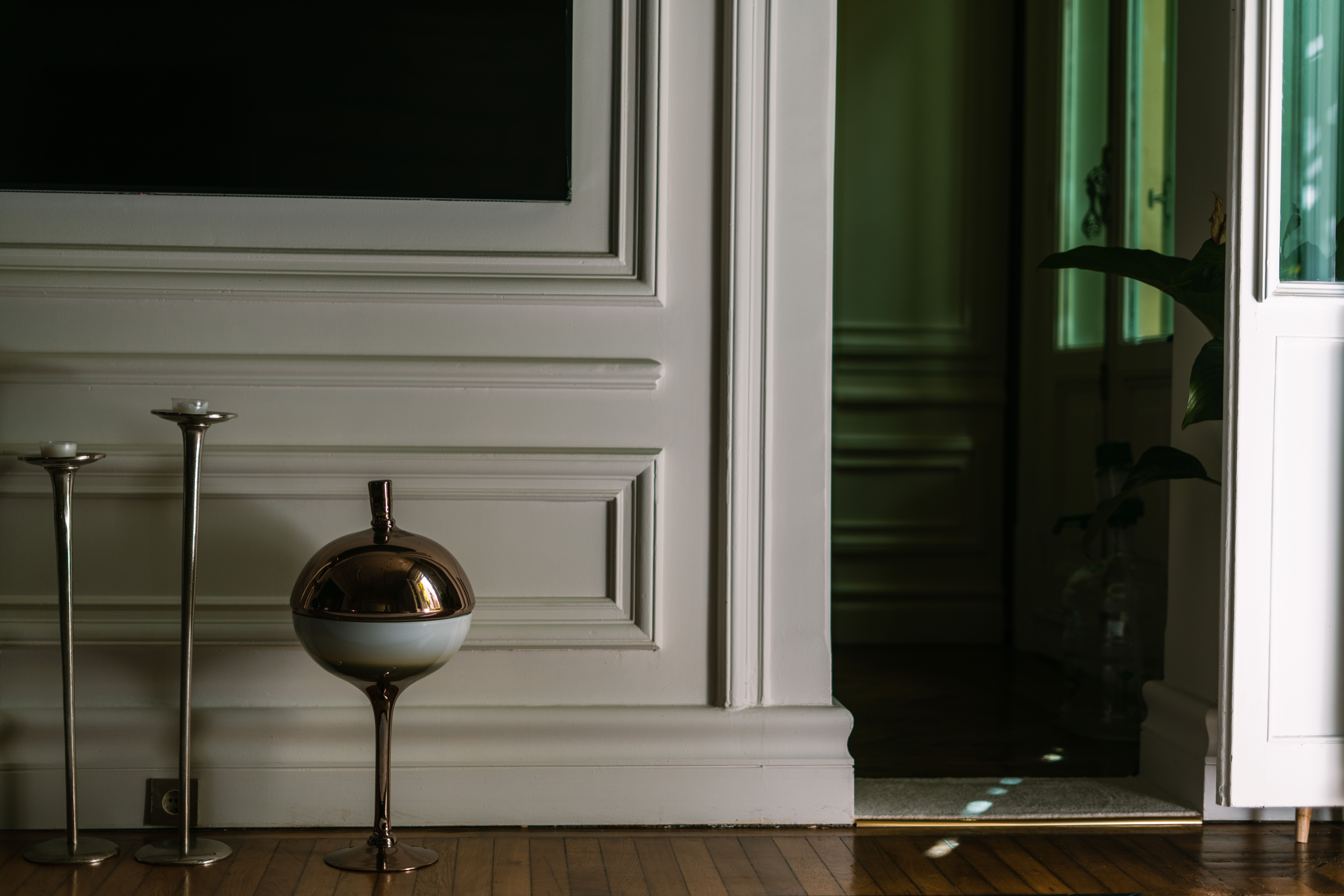
Sometimes, even a very light, tone-on-tone composition is enough. Because it is not always about adding more. Sometimes it is simply about drawing what is already there more beautifully.
Boiserie should never be designed as an isolated decorative element.
There are doors. Skirting boards. Windows. Sockets and switches. A fireplace. The bedhead. A wardrobe. Even the point from which you enter the room changes the way a wall is perceived.
The mouldings should respond to all of these elements. This is why simply dividing a wall into three or four identical rectangles is rarely enough.
You often hear about the one-third / two-thirds rule.
It is a useful compositional reference, but it should never be applied automatically. A low boiserie may work beautifully in one room and feel entirely out of proportion in the room next door.
With low ceilings, even greater care is needed. Too many horizontal lines, heavy profiles or dense compositions can visually compress the room. In these cases, we often prefer finer mouldings, more vertical proportions and, above all, more breathing space on the wall.
Two mouldings that appear almost identical can produce completely different results. A slim profile tends to feel more contemporary and discreet. A deeper one creates stronger shadows and immediately introduces a more classical language.
There is therefore no universally “correct” thickness. The right one is the one that is proportionate to the ceiling height, the scale of the wall and the overall language of the interior. In a small apartment, a substantial profile can unintentionally become the main feature. In a large room with high ceilings, one that is too delicate can almost disappear.
Tall vertical panels. Lower rectangular sections. Double mouldings. Half-height boiserie. Full-height panelling. The possibilities are almost endless. But the pattern should not be chosen simply because it looked beautiful in a photograph.It needs to follow the rhythm of the wall.
An off-centre doorway, for instance, can completely alter the composition. So can a wall that continues into a corridor or meets a fireplace. This is precisely the point at which boiserie stops being decoration and becomes design.
Warm ivory, greige, taupe, muted green. When the wall and the mouldings are painted in the same colour, the boiserie is read through light and shadow rather than contrast.
The result is quieter. And often far more sophisticated. The decoration remains, but it does not need to announce itself.
It depends entirely on what we want to achieve. For a lighter intervention, decorative mouldings applied directly to the wall and painted afterwards may be all that is needed.
For more elaborate compositions, lacquered MDF and made-to-measure panelling can offer greater control and precision. Timber, on the other hand, takes the project into a different realm. It is no longer simply a design drawn onto a wall, but becomes material, joinery and architecture.
Then there are contemporary full-height boiseries, capable of integrating doors and wardrobes until they almost disappear into the composition. There is no single option that is better than the others. There is only the one that is right for that particular home.
If you are considering boiserie, have the entire wall designed before choosing the moulding itself. Not just one panel. A well-designed composition takes into account ceiling height, doors, skirting boards, furniture, electrical points, proportions, sightlines and continuity with the adjoining rooms. They may seem like small details. But it is precisely their combined effect that makes a boiserie feel natural — as though it had always belonged to the house.
We can study its proportions, rhythm, materials and detailing together, designing it around the real characteristics of your space.
Write to us at info@aqhitalia.com and tell us about your home.




.png)